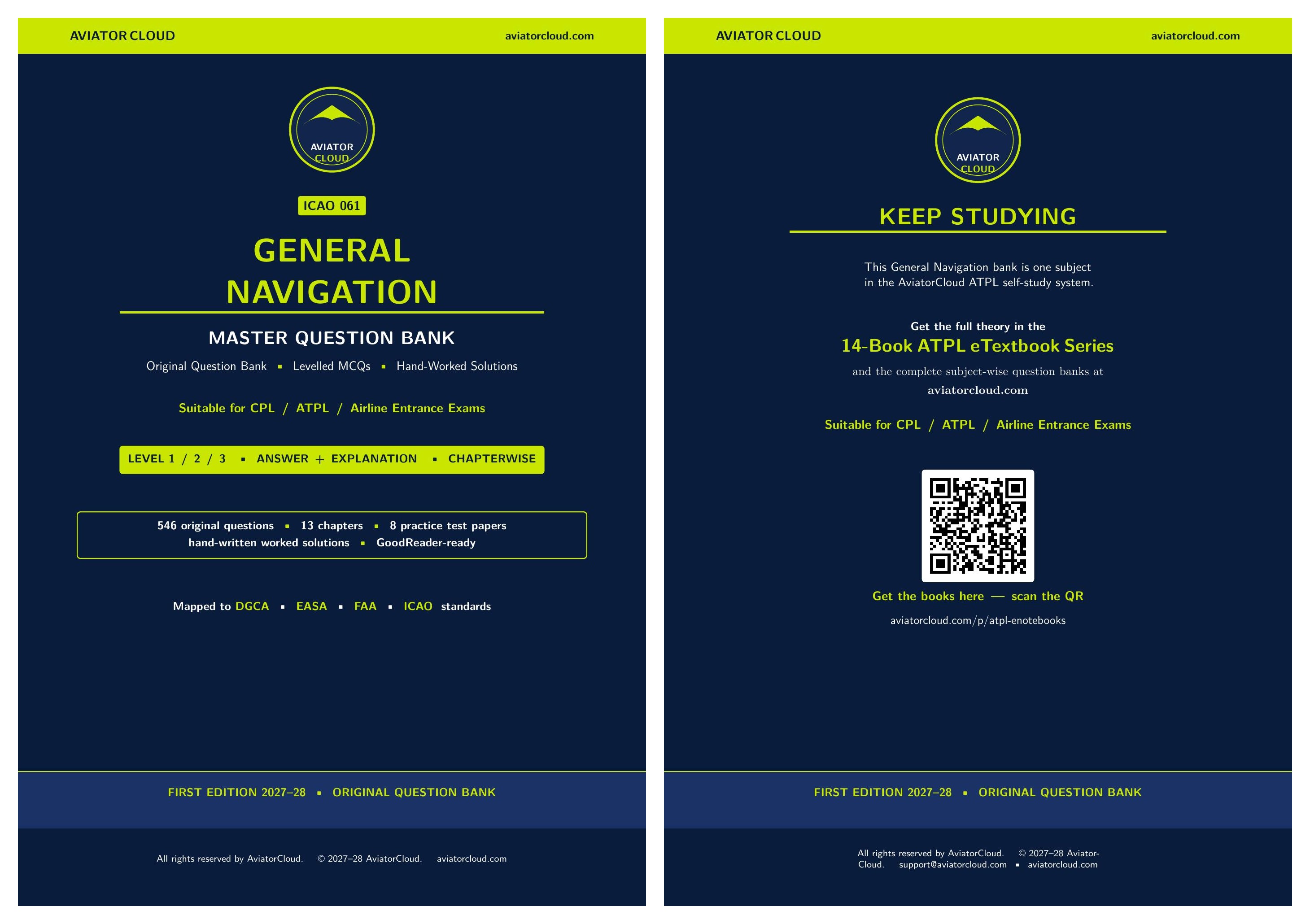
Download Air Navigation QB ( General Nav + Radio Aids + Instruments )
Are you gearing up for the CPL or ATPL Air Navigation exams? Look no further! We bring you the ultimate question bank download to help you soar through the exams with ease.
Our comprehensive question bank is packed with hundreds of practice questions meticulously curated to cover all the crucial topics of the exam from General Navigation + Radio Aids + Instruments ) With this indispensable resource by your side, you'll be fully equipped to tackle any challenge the exam may present.
Our team of aviation experts has meticulously crafted the question bank to closely resemble the actual CPL and ATPL Air Navigation exams, ensuring that you receive the most relevant and up-to-date practice materials available. Our Aviator Cloud Air Navigation Question Bank covers all major question banks like CAE Oxford, Aviation Exam , Indigo QB , Volare and provides all original MCQ, (No copy) The questions are designed to rigorously test your knowledge and comprehension of the subject matter, with in-depth explanations and feedback provided for each answer.
Our user-friendly interface allows you to study at your own pace, whether you're at home or on the move. Access the question bank from any device and study whenever and wherever you want.
Furthermore, our Air Navigation Question Bank is regularly updated to incorporate any changes in the exam format or content. This ensures that you are always equipped with the most accurate and current practice materials available.
Don't leave your success to chance – download our Air Navigation Question Bank today and gain the advantage you need to excel in the CPL and ATPL exams! With our all-inclusive practice materials and easy-to-use interface, you'll be fully prepared to ace the exams and propel your aviation career to new heights.

WHY BUY THIS QUESTION BANK
- 2,700+ original MCQs — across General Navigation, Radio Aids and Instruments, each with a complete, hand-worked solution, not just the answer letter.
- Three difficulty levels — Level 1 easy, Level 2 calculation, Level 3 hard, plus a dedicated Exam-Standard (ECQB) block per chapter that mirrors the real paper.
- Advanced systems included — EICAS and ECAM, autopilot / autoland / autothrust, Airbus fly-by-wire and protections, FMS, N1/EPR engine monitoring — the modern glass-cockpit depth today's exams expect.
- 100% original and current — authored to the latest syllabus, never copied, genuinely up to date and reliable.
- Verified, not error-prone — every numeric answer is machine-checked and independently re-derived, then run through a multi-pass accuracy audit.
- DGCA / EASA / FAA / ICAO mapped — each question is tagged to the authorities that test it, with dedicated regulator-difference questions — DGCA-first, no wasted study.
- Exam-style figure questions — RMI / CDI bearings, instrument faces and EFIS / ECAM displays — read the figure, then answer, exactly like the actual exam.
- Mocks and practice papers — chapter mock papers and full combined practice tests with printable OMR answer sheets — sit timed mocks and mark yourself.
- Teaching-style explanations — worked the way an instructor solves it by hand, so you learn the method instead of memorising the answer.
- Bookmarked, offline PDF — level-sorted and fully bookmarked (GoodReader-ready) for instant navigation, works offline on any device.
- Mimics the real exam — designed around the actual CPL / ATPL and airline-entrance papers, for self-paced mastery.
- Lifetime access — free updates and improvements as the syllabus and exams change — buy once, keep current.
SEE INSIDE — A FEW QUESTIONS FROM THE BANK
The correct answer and full working are shown under each question.
GENERAL NAVIGATION
Q1 LEVEL 3 · HARD
The great-circle track A to B (B east of A, Northern Hemisphere) is 074°T at A. Both points lie on 52°N and are 25° of longitude apart. The great-circle track at B is:
A. 054.3°
B. 093.7°
C. 086.4°
D. 100.0°
Correct answer: B
Working. Convergency = change of longitude x sin(latitude) = 25 x sin 52° = 25 x 0.788 = 19.7°. Going east in the Northern Hemisphere the great-circle track increases by the full convergency, so at B it reads 074 + 19.7 = 093.7°. (The rhumb-line track sits midway at 083.9°.)
Q2 LEVEL 2 · MEDIUM
An aircraft climbs at a constant Mach 0.80. As it climbs through progressively colder air toward the tropopause, the TAS for that fixed Mach number will:
A. Increase, because the local speed of sound rises
B. Decrease, because the local speed of sound falls with the colder air
C. Stay constant, since Mach is fixed
D. Increase, because density falls
Correct answer: B
Working. TAS = Mach x LSS, and LSS = 38.95 x sqrt(T in Kelvin). Climbing into colder air lowers the temperature, so the local speed of sound falls; at a fixed Mach the TAS therefore decreases. Do not confuse this with the constant-CAS climb, where TAS rises — here Mach, not CAS, is held.
RADIO AIDS
Q3 LEVEL 2 · MEDIUM
On a two-needle RMI, heading 050 is under the lubber line and the green single-bar pointer (the VOR) has its head on 110. What is the magnetic bearing TO the VOR (QDM)?
A. 050°
B. 290°
C. 110°
D. 060°
Correct answer: C
Working. Because the RMI card is driven by heading, the head of a bearing pointer reads the magnetic bearing TO that station straight off the card. The green VOR head sits on 110, so the QDM is 110°. Check: QDM = heading + relative bearing = 050 + 060 = 110.
INSTRUMENTS
Q4 LEVEL 3 · HARD
A pilot reports: “the affected system diagram appeared on the LOWER screen by itself, and the actions to carry out were listed on the UPPER screen.” On the Airbus ECAM this is correct because:
A. The SD (lower) auto-displays the failed-system synoptic while the E/WD (upper) lists the corrective actions
B. The E/WD shows the synoptic and the SD shows the actions
C. The PFD shows the synoptic and the ND the actions
D. Both screens show the same synoptic
Correct answer: A
Working. On a failure the ECAM automatically calls the relevant synoptic onto the lower System Display (SD) so the crew see the system state, while the failure title and the blue action lines are written on the upper Engine / Warning Display (E/WD). Actions are read on the upper screen; the picture is on the lower.
Q5 LEVEL 3 · HARD
During an approach the speed decays toward the stall and the Airbus ALPHA-FLOOR protection triggers. The autoflight / autothrust system responds by:
A. Reducing thrust to idle to lower the angle of attack
B. Commanding TOGA thrust automatically, then latching it as TOGA LK until the crew cancel it
C. Disconnecting the autothrust and flight directors
D. Trimming the stabiliser fully nose-down
Correct answer: B
Working. Alpha-floor is a low-speed protection that, at a high angle of attack, commands full TOGA thrust automatically regardless of thrust-lever position. Once the condition passes it latches the thrust as TOGA LK (TOGA lock), holding go-around thrust until the crew deliberately cancel it.
Sample questions above are taken directly from the bank.
WHAT YOU GET
A professionally typeset, fully bookmarked PDF question bank containing:
- Level-sorted MCQs (Level 1 / 2 / 3) with complete worked solutions
- Chart and diagram questions (RMI / CDI, instrument faces, EFIS / ECAM)
- Exam-Standard (ECQB-level) problem sets
- Full combined practice tests with printable OMR answer sheets
- eTextbook QR access on the back page
GET INSTANT ACCESS